

NASA Launches Artemis II, Their Most Ambitious Mission Yet
- Oskar Tsaur, Khanh Do
- May 27
- 3 min read
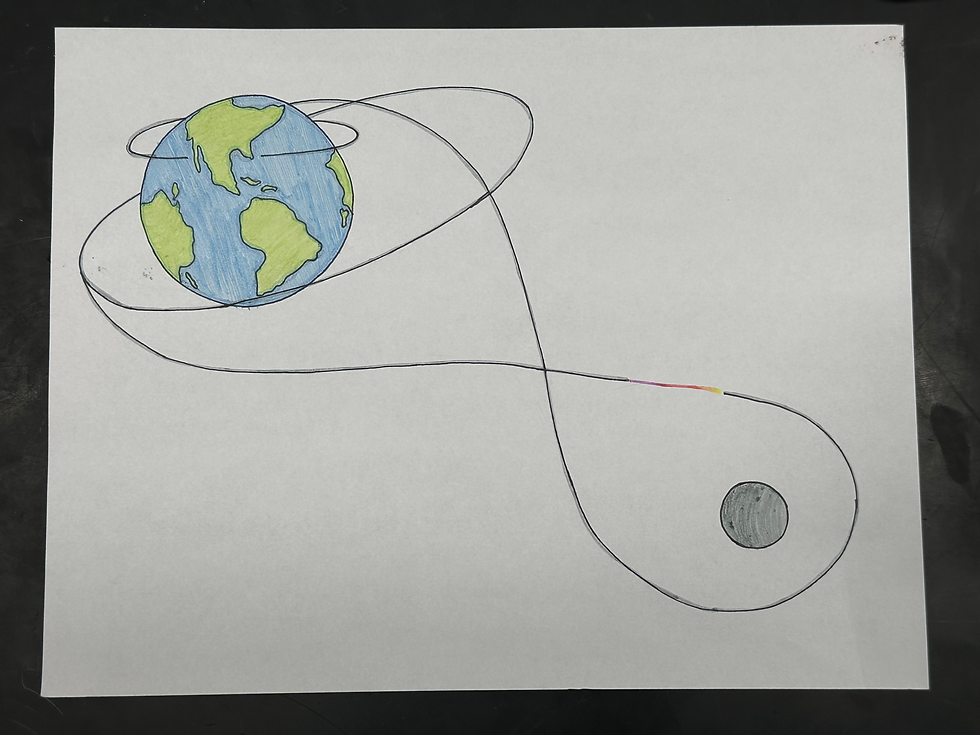
On April 1, the Artemis II mission commenced, with the Orion spacecraft launching from the Kennedy Space Center at Florida. The mission lasted for ten days and four brave and accomplished astronauts manned the mission. This is NASA’s most ambitious mission yet, as it transported humans to the furthest mankind has ever been from the Earth and initiated the next set of missions to colonize outer space.
“It’s really the first big venture we had in space in a really long time.” Kason Lai (12), Math club president, stated. “We haven’t gone out much, so Artemis 2 marks a very important step as humanity tries to expand outside of the Earth.
Over the course of ten days, there was a variety of testing to be done. Day 1 test out systems like the potable water dispenser that will hydrate the astronauts and their food. When the spacecraft reached a certain distance, the astronauts will perform an additional engine firing to put Orion on the right path for translunar injection burn, enabling the stagecraft to set out on the right path when reaching lunar orbit. Day 2, 3 and 4 included more testing with the communications system, emergency procedures, and taking imagery and documenting the sights they encounter out in space. On Day 5, Orion enters the lunar sphere of influence, where Moon's gravity takes over predominantly. Day 6 marked the closest the crew will be to the moon, and breaking Apollo 13's record of being the most distant away from Earth (248,655 miles), and more documenting will commence. Day 7, 8 and 9 includes relaying back information to Earth, assessing their ability against high-radiation environments, and preparing for re-entry to Earth. On Day 10, Artemis II's crew module separates from its service module to expose a heat shield, advancing back onto Earth's atmosphere, and parachutes will deploy. NASA and U.S. Navy personnel awaits the crew at the Pacific Ocean, the landing site of the mission.
The Artemis mission will serve as a testing interval for NASA’s ultimate mission of establishing mankind’s presence on the moon, which includes the sustainability of their spacecraft systems and procedures. It would be the first time in over 50 years (since Apollo 13), that humans would be in the vicinity of the moon. In contrast to Apollo 8, Artemis II will fly around the moon but not enter lunar orbit, marking the reason it is the farthest humanity will be from the Earth.
The ingenuity of Artemis II was picked up on social media, the most captivating aspect to netizens being the four astronauts manning the mission. Reid Wiseman served as the mission's commander, who is a NAVY veteran and pilot who also served as Chief of NASA's Astronaut of Office. Victor Glover pilots the mission as the first person of color to go to the Moon. Christina Koch, an electric engineer and astronaut, is a mission specialist and is the first woman to go to the moon. Jeremy Hansen used a fighter pilot in the Royal Canadian Air Force before joining the Canadian Space Agency as an astronaut, and he served as the mission specialist. These four astronauts hold various accolades that solidify their spot, either performing several spacewalks or flight missions that requires extreme expertise.


Comments