.png)
MVROP Music Production Class Vibrates With Passion
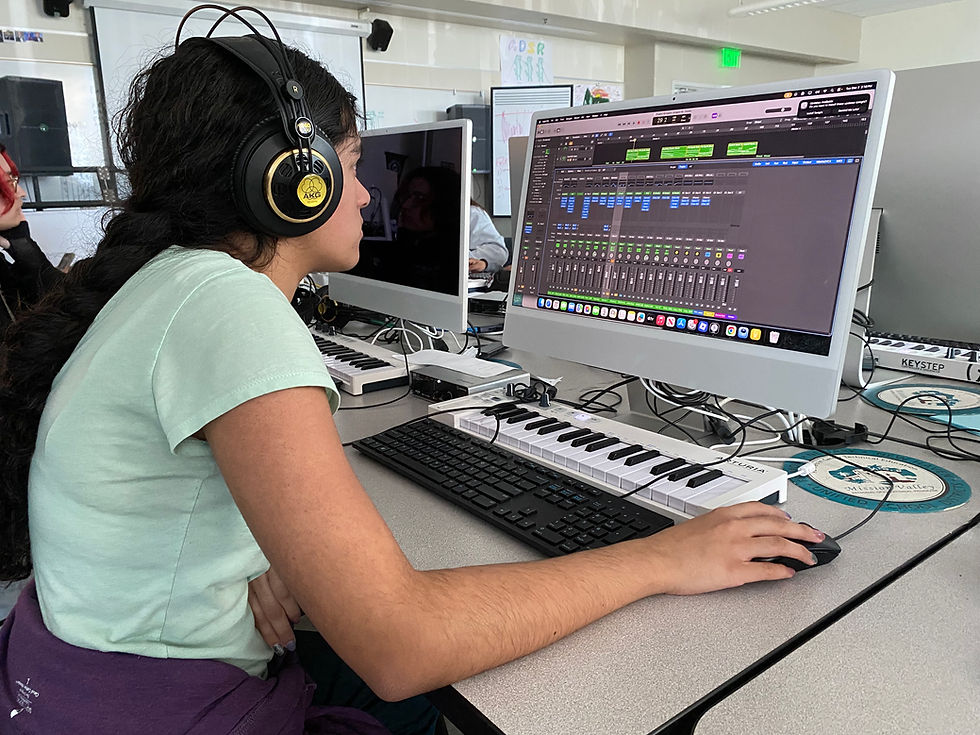
What’s that noise? Loud music and vibrating beats are usually not expected in Mission Valley’s Regional Occupational Programs’ (MVROP) environment, but when it comes to music productions, that’s a different story. Common questions arise, such as how much homework students get or how much the tests are worth, but looking deeper into the passions and motivations of the students helps people understand the complexities of this class. Christiano Angeles (12), James Logan High School student, mentioned what made him interested in music productions and why he took it. “It started because of a video game I was into [Friday Night Funkin] and that’s when I started experimenting with GarageBand which was my first digital audio workstation…,” Angeles said. “I took the class because it’s in the arts and I had a lot of free classes so taking this class will allow me to open up to new genres of music and talk about music with other people.” Sara Erande (11), Irvington High School student, stated, “I’ve always been interested in music since I was a kid but I never realized I was someone who could create music until I was older… [also] to learn music productions and learn how to get more advanced and find what type of music I want to make and improve in other areas [like singing] so I can become better at it.” DAW, also known as a Digital Audio Workstation, is a type of program used to compose and arrange music. While music productions use Logic Pro X, there are cheaper and easier options. Angeles uses FL Studio and GarageBand while Erande uses BandLab. BandLab and GarageBand are free apps while FL Studio is a one time purchase, meaning when you buy an edition, you don’t have to pay for anything else afterwards. Before coming into this class, students mentioned what they looked forward to learning in music productions.
“Mixing is one of them. Just making my music sound more pleasing no matter where you are; especially in a car since music tends to sound really weird in a car because it’s very stereo based… also just to figure out what job I can do that’s related to music that can be a stable job for me,” Angeles said.
Erande stated, “I’m looking forward to learning about the basic stuff of making music like strong structure or making melodys… mixing because it’s complicated… also live sound which is interesting to me.” People may wonder what the students learn. Erande and Angeles expressed their favorite and least favorite units.
“I know it was everyone's least favorite but I would say the music theory unit because I love helping people with music since I did a lot of personal research [in music theory]. It was something I was used to and it showed that [learning] these skills finally paid off,” Angeles said. His least favorite unit was the serum unit, which is a synthesizer wavetable plug-in that helps create and modify sounds from scratch. It was his least favorite because he was already familiar with the concept of serum and he used a plug-in that was similar to it.
However, Erandes’ favorite unit is serum and learning about logic pro functions while her least favorite was music theory. She disliked how hard it is for a beginner and how fast the unit went. The final test was also worth a lot of points.
“I like serum in general because once you understand it, it gives you a lot of freedom. You don’t have to use presets and you can make stuff on your own,” said Erande.
As they explored more about the class, Angeles and Erande mentioned their favorite parts about the class in general.
“The best part is we can use advanced DAW like Logic Pro… Also, being in an environment where you can focus on your passion and there are no distractions. It’s kind of therapeutic and gets you away from the rest of the world,” expressed Erande. While music productions is a fun class, students had different expectations before coming in. Erande and Angeles explained what they wished they knew before they took the class. “It’s not just for beginners but for advanced students. I wish I also knew how in-depth we would be going like the functions in Logic Pro and music theory. I thought it would be beginner oriented but it’s for all levels,” said Erande.
Angeles stated, “...That we were going to work with the sound design students. We’re similar, but there are times where our teacher has to juggle between the sound design students and music kids.” This is the first year music productions and sound design are combined and collaborating. While being passionate about music productions now, they were asked if they would continue doing music in the future. “It’s 50/50 for me because I’m pretty nervous about making music a job of mine because of how risky being in the arts is…” Angeles stated. “When it comes to music, it’s a hobby that I have but I hope that I don’t get a job [in music] where it is unstable. That’s my greatest fear. I would still like to explore more about music.” “For sure. Music is already a big part of my life so it will definitely be there and music production is a way where I can express myself,” said Erande. When it comes to creating music, they were asked how they knew what pieces or sounds would fit well together in order to create the song. “I have a playlist of music references, I use rhythms and patterns from other songs that I’ve heard before and just learned that combining songs that you like can make your identity when it comes to music,” said Angeles. “I feel like it’s mostly what music I already listen to, like I would listen to a song and go ‘Wow that synth is really cool I want to do something like that or that drum pattern is really cool I should incorporate that,’” Erande added. “Most of it is just kind of in the moment I just play around with it, there’s no specific formula or steps or anything.” There is no specific time length to make and complete a song. For some people, it might take months, for others, it might take years. For Angeles, it takes him one to two months entirely on a project because he also works on other songs. For the music production final, it takes him two to three weeks to finish a song.
“It depends a lot. Sometimes I make a song fast because I’ve formed it in my head already, but most of the time it takes longer like two to three weeks depending how much time I have,” Erande said. Angeles and Erande gave their last words and advice to those who are interested in taking this class.
“Doing your research outside of school can help you bond with the teacher and even if you don’t know how to do something in the software, doing your own research can pay off especially because of how many variations of music there are. It can take you a lot of places. Keep exploring when it comes to music and keep a playlist of music or sounds that you want to keep as a reference someday,” Angeles advised.
Erande added, “If you’re interested in music or producing music you should definitely take this class. Especially if you want to pursue it as a career, this class is quite helpful because it’s technical. [For] beginners who are pursuing it as a hobby like me, it’s still nice because it’s so different from what we do for the rest of the day like school or at home, it’s a nice break.”


Comments